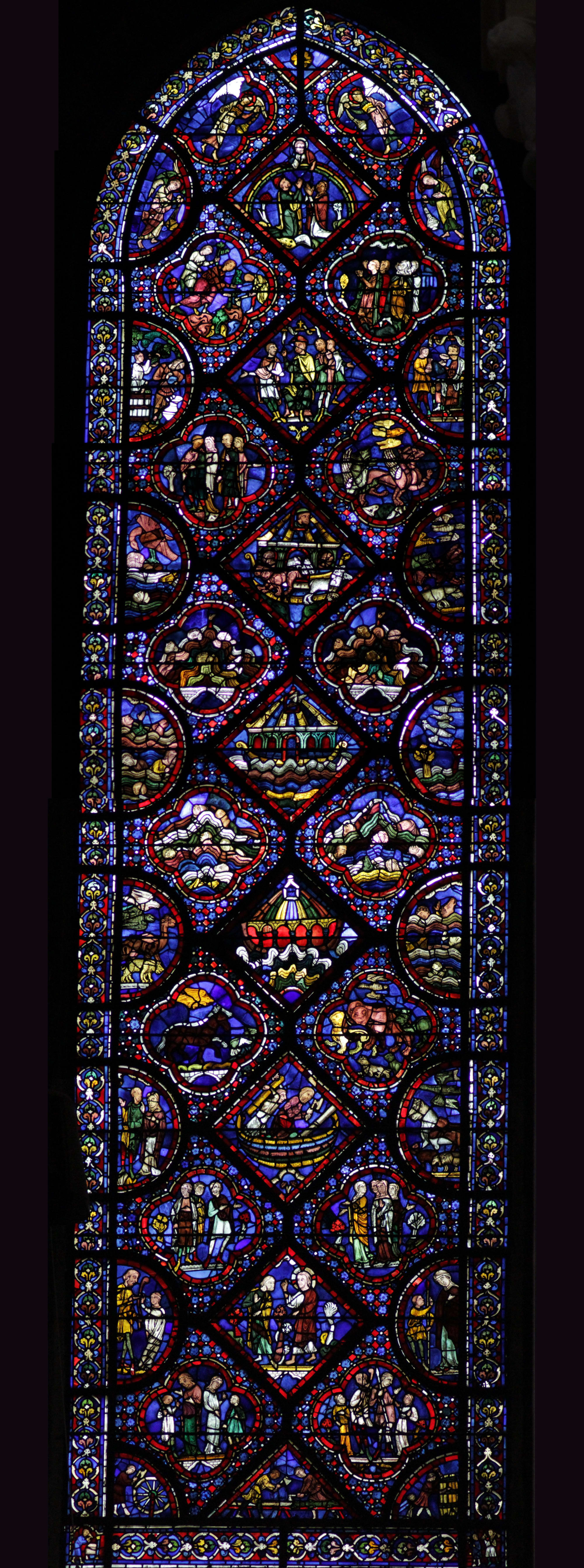
Noah's Ark at Chartres
Reading a medieval stained glass window, panel by panel
Photo by Micheletb, Wikimedia Commons, CC BY-SA 4.0
The Donors
We begin at the very bottom of the window — the place of honor reserved for those who paid for the glass, known as the donors. Chartres cathedral is famous for its images of medieval tradespeople; bakers, fullers, and furriers. Many of the artisans who worked on building the cathedral are also donors who left a lasting visual legacy of their handiwork. The Noah window was donated by cartwrights, coopers, wheelwrights and carpenters. These craftsmen worked in wood, and so they chose to sponsor the story of the most famous woodworker in scripture: Noah.
The Donors
Here, two workers shape a wooden beam. Is it for the ark, or for the cathedral?
Wheelwrights
Here we have a wheelwright shaping a wheel. In the corner you can also find another wood worker using an axe.
Coopers
Here is a cooper working on a barrel. This image foreshadows Noah's experience as a vintner, reflected above.
The Antediluvian World
Above the donors, the story begins. These panels depict the world before the Flood — giants, the sons of God, and the daughters of men. The imagery is cryptic, drawn from Genesis 6, and scholars still debate exactly what several of these scenes represent.
God Speaks to Noah
In a single powerful medallion, God addresses Noah directly. The divine figure gestures toward Noah, commanding him to build the ark. The composition is stark — two figures against a colored ground, the entire fate of creation suspended between them.
Noah's Family
The sons of Noah, Shem, Ham, and Japheth, appear alongside Noah's wife and daughters-in-law. These are the seven souls who will survive the Flood along with Noah. The glassmaker gives each figure distinct posture and color, despite working at a scale of just inches.
Building the Ark
Noah sets to work. In one panel he builds the ark, an echo of the carpenters in the donor panels below. In an adjacent scene, a man and woman converse, perhaps discussing the coming catastrophe. The ark at this point looks a lot like a barrel and the tools are the same as those used by the donors.
The Animals Arrive
A procession of creatures approaches the ark: pairs of lions, elephants with tusks, birds, and even two cats or panthers. Some animals would have been familiar as domestic farm animals, but these exotic specimens might only have been seen by the artist in a medieval bestiary.
The Ark Afloat
The completed vessel rides the floodwaters. This is the image at the heart of the window: the ark floating on a stylized sea of glass that looks a bit like an inverted rainbow. The curved hull is unmistakable, a symbol of salvation that would have been legible even from the nave floor far below. The glowing interior recalls the stained glass windows themselves.
Victims of the Flood
While a few animals manage to make it to board the ark, below and around it, they drowned. Tiny figures struggle in swirling water, bodies contorted, limbs flailing. The medieval artist does not look away from the catastrophe. These panels are among the most emotionally charged in the entire window. Look at the terrified facial expressions of both people and animals.
Drowning
The facial expressions of the victims evoke a strong feeling among viewers hundreds of years later. People raise their hands from the waters, hoping to be rescued.
The Dove Released
A dove flies from the ark. In the adjacent panels, a dove flies above the receding waters while bodies still float. This is the turning point of the narrative: the moment hope returns. To the right, the dove sallies forth, then returns, carrying a small olive branch in its beak as trees appear above the waters.
The Waters Recede
As the waters recede, more victims appear while Noah supervises the ark's safe landing. The animals walk down an exit ramp. The repetition is deliberate; the glassmaker wants the viewer to understand the scale of destruction. The Flood was not a gentle rain. It was the undoing of a world. To the left, a bird pecks on a corpse, but to the right, flying birds chaperone the safe exit of the animals.
Noah's Sons and Their Wives
The survivors are shown together — Noah's three sons and their wives, the eight people from whom, according to Genesis, all humanity descends. The composition is calm and symmetrical after the chaos below.
The Vineyard
Noah plants grape vines — the first act of agriculture in the new world. His sons and their wives kneel nearby. The scene is peaceful, domestic, a deliberate contrast with the violence below. The cheerful winemaking scene is another celebration of the cooper's art. But trouble is coming.
The Drunken Noah
Noah makes wine and drinks, witnessed by his son Ham; Noah curses Ham's son Canaan. Even after divine salvation, human weakness persists. The glassmaker renders the drunkenness without judgment, simply as fact.
God's Covenant
God makes a covenant with Noah and his wife — the promise never to flood the earth again. This is the theological climax of the window, placed near the top where it catches the most light. The rainbow, God's sign, where God hangs over to address Noah, would have been understood by every medieval viewer.
Angels with Censers
At the very top of the window, angels swing censers — vessels of incense that signify prayer rising to heaven. These celestial figures crown the entire narrative, framing the human story below within the order of the divine.
The Full Window
Pull all the way back. Forty-two panels, read from bottom to top, telling a single story across eight centuries of transmitted light. The donors who paid for this glass are long forgotten, but their window endures — a narrative in color that still works exactly as intended.